Society
Where does 98% of the mass of ordinary matter come from? new discovery
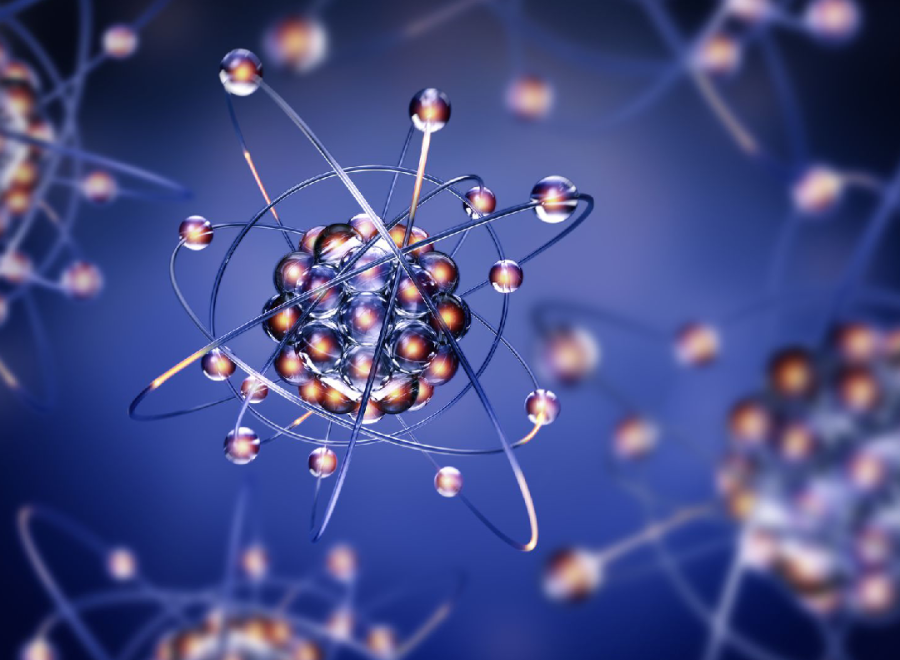
Protons and neutrons, the basic "building blocks" of atomic nuclei, are hundreds of times heavier than the sum of the masses of the three quarks of which they are composed. The Higgs mechanism, discovered in 2012, is responsible for only 1–2% of the mass of nucleons. The other 98% came out of nowhere, and until recently no one could describe exactly how. The answer was found in Quantum Chromodynamics. An international team of physicists from the Jefferson National Accelerator Laboratory (Jefferson Lab, USA) has published a paper in the Symmetry journal that is considered to be the most complete explanation to date of the birth of hadrons, a mass of particles participating in the strong interaction. According to Quantum Chromodynamics (QCD), the mass of a proton is almost entirely energy enclosed in the fields of quarks and gluons. Inside the proton, the gluons are capable of interacting with themselves, creating incredibly complex and distance-varying dynamics. At small distances (on the order of the size of a proton), quarks cease to be "naked" and are surrounded by a cloud of virtual particles, becoming "dressed". It is in this state that each quark acquires a dynamic mass of about 400 MeV, and three such "dressed" quarks, interacting with each other, give a proton with a mass of almost 1 GeV (938 MeV). This is 98% of the mass of ordinary matter. Since the 1990s, Jefferson Lab has been collecting data on the structure of the proton and its excited states at the CEBAF accelerator. Using Schwinger's continuum approach, the scientists were able for the first time to match theoretical calculations of the CQD with actual experimental observations over the entire range of distances. The result is clear. it is the "dressing" of the quarks and the dynamics of the strong interaction that completely explain the mass of the proton and other hadrons. The data from the old 6 GeV program covered the zone where about 30% of the mass is born. The current 12 GeV program has already reached the halfway point. Future experiments with more energetic beams will allow us to "see" the entire range and finally close the question. "When we have the complete picture, we will really understand how almost the entire mass of the visible Universe is born from almost massless quarks," Viktor Mokeev, one of the authors of the study, emphasized.